
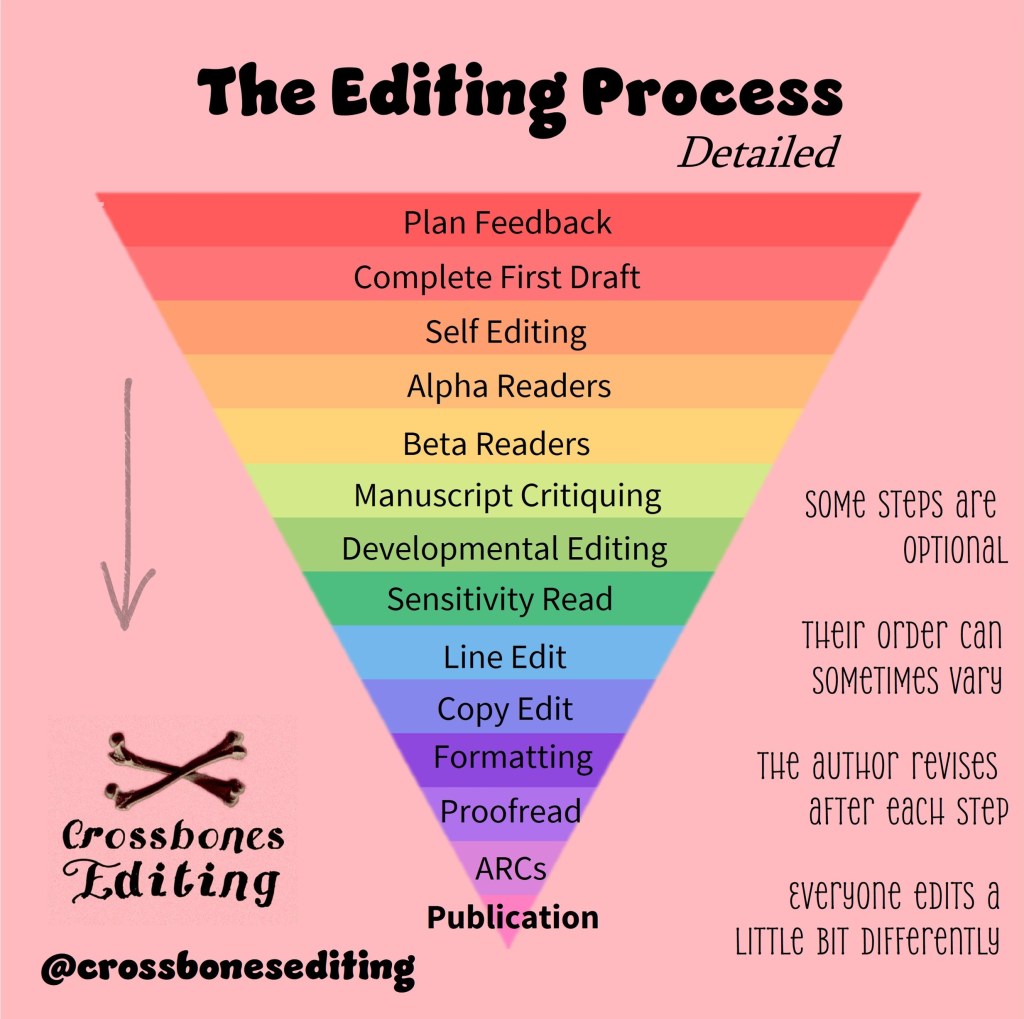
Between having an idea for a book and publishing said book, there are a whole lot of editorial steps that go into making sure an author is publishing the best possible version of their story. Here is a step-by-step guide of the editorial process.
First, remember:
- Some of these steps are optional and will not be necessary for every single novel
- The order of these steps can sometimes vary (e.g. proofreading and formatting often switch)
- The author revises their manuscript after every step to ensure cohesion
- Everyone edits a little bit differently, and the editorial process is not set in stone.
- I’ve tried to be as broad and inclusive as possible in this outline
1. Plan Feedback
If you’ve planned out your entire novel in dot points or chapter summaries but want a little bit of outside feedback before you start writing, getting plan feedback is an excellent option.
While it is not a widely offered editorial service, plan feedback can include very early developmental comments, advice for character development, and professional opinions on major plot points. I offer this service!
2. Complete first draft
Next, complete your first draft. At this point, it is vital to just get the words written, and not strive for perfection. If you try to write a flawless draft, it will never be complete.
3. Self editing
Now you have your perfectly imperfect first draft, it’s time to self-edit. This is one of the most important steps in the editorial process and cannot be skipped. An author should never type ‘The End’ and send their manuscript off to an editor in the next breath.
Self-edits help to identify and fix some of the most basic errors, which then allows a hired professional editor to focus more on in-depth issues and broader consistency errors. There are also some elements of editing (e.g. plot, characterisation choices, and the basic story line) that only the author can work to fix. Other simple errors to look out for in self-edits include overused words, slight inconsistencies, missing punctuation marks, and tense slip ups.
Don’t feel like you have to catch every single error in the self-editing stage! That’s what the next several steps are for.
4. Alpha reading
Once your manuscript is a bit more polished (and you’ve read it yourself a million times) it’s time to share it with alpha readers. These can be people that are not necessarily professional writers or editors, and perhaps not even avid readers; they are people close to you that you trust to read your manuscript and give honest, open feedback.
Your alpha reader/s may be your mum or dad, your sibling, your partner, or your bookish bestie. I think it’s valuable to have some kind of personal relationship with your alpha reader/s, as you are subject to vulnerability sharing your story with another person for the first time, and it’s important to feel safe and unjudged.
5. Beta reading
After alpha readers come beta readers. Where an alpha reader is anyone you trust to read your manuscript, a beta reader is someone who specifically enjoys reading (particularly the genre of your manuscript) and can thus give genre specific feedback and suggestions based on trope efficiency. Given their knowledge of the genre, beta readers can also sometimes comment on the novel’s potential marketability.
Most beta readers offer their services free of charge, though some who have an editorial background may charge a small fee, as their editing experience inevitably informs their comments.
6. Manuscript critiquing
Also known as a manuscript review or a manuscript evaluation, a manuscript critique is often the first paid professional step in the editing process post-draft completion. These critiques involve a professional editor or writing coach looking at the manuscript as a whole and commenting on things like the world/setting’s immersion, the plot’s pacing, and the protagonist’s characterisation and likability. Comments may also be made on the author’s individual writing style and the prominence of their unique voice in their writing.
In essence, a manuscript critique celebrates the manuscript’s strengths, and carefully evaluates the manuscript’s weaknesses.
7. Developmental editing
There are some similarities between a manuscript critique and a developmental edit, but the latter is less broad and more specific. Developmental editing aims for cohesion in every aspect of plot, characterisation, time period, and environment.
Editors focusing on developmental corrections will often identify weak plot points and offer alternatives, clarify narrative tone and voice, make suggestions on character traits or characteristics, highlight inconsistencies, and point out necessary scene additions to improve the story’s validity. I offer this service!
8. Sensitivity reading
A sensitivity reader is someone who identifies any sensitive topics or issues mentioned in your manuscript and ensures you have written about them in an appropriate, accurate, and respectful manner. Such topics may include mental health, disability representation, sexuality and gender representation, and cultural practices, beliefs, and traditions. If a character uniquely exhibits or struggles with any of these concepts, a sensitivity reader will ensure their actions, speech, and thoughts align with this, while also ensuring fellow characters reference and interact with this character aptly.
The aim of sensitivity reading is to reduce harm caused by oversight or lack of knowledge and make informed decisions regarding sensitive topics to reduce offence and ignorance.
9. Line editing
As the name suggests, line editing corrects errors on a line-by-line level. Editors conducting a line edit will reword sentences to eliminate wordiness and maintain varied but effective sentence structure, correct phrasing or sentence fragment errors, and suggest different word choices where revision for meaning is needed.
A line edit aims to improve clarity and readability, avoid cliché, eliminate word/phrase overuse, correct jargon and slang, and maintain consistency throughout the manuscript. A lot of editors (including me!) offer a service that combines line editing with copy editing.
10. Copy editing
A copy edit focuses on the nitty gritty of grammar, spelling, and punctuation. Where a line edit corrects errors on an individual line level, a copy edit corrects errors on an individual word level. Editors conducting a copy edit will ensure all punctuation is precise, spelling and capitalisation is correct and consistent throughout, and all grammatical rules are followed accurately.
Copy edits (and line edits, in some respects) will also ensure your manuscript adheres to any chosen style guide, and more importantly, your chosen variation of English (e.g. Australian, US, UK).
11. Formatting
Now, it’s time to format your manuscript and get it looking like a proper novel. There are several formatting programs (e.g. Vellum, Atticus, Scrivener) that you may choose to use to format your novel yourself. You can also find many bookish businesses that offer paid professional formatting services.
There are many things to keep in mind when formatting your manuscript, including: font (style and size), header and footers, page numbers, chapter headings, titles, scene break symbols, line and paragraph spacing, indentation, page sizing, margin sizing, and the layout of special extras (e.g. art, hand written notes, texting bubbles, maps, etc).
Some authors choose to get their novel formatted before it is sent to proofreaders, so they are experiencing it more (visually) like a realistic book, but this decision comes down to personal preference.
12. Proofreading
After line edits, copy edits, and author revision, your manuscript is sent to a proofreader. This is the last professional line of defence against slight mistakes and inconsistencies. By this stage in the editing process, there should be very few things left to correct. Still, it is inevitable that some small typos and errors will slip through the editorial chain, unnoticed, all the way to the proofreader. A proofreader will also catch any errors that are made while an author adjusts previous editorial feedback. I offer this service!
13. ARC readers
ARC stands for advanced reader copies. Prior to publication, authors send out free copies of their fully edited (complete) novel to ARC readers, often in exchange for honest, preliminary, written reviews. ARCs help to build hype for upcoming releases, and also catch any final errors that yet again slipped through the proofreading editorial stage.
14. Publication
Yay! Your novel is published! And boy, has it come a long way since you first had that idea to write a book. Post-publication, give yourself a big pat on the back, and celebrate any and every resulting success.
Other things to consider when publishing your novel:
- Cover design
- Character/promotional artwork (commission real artists, not AI!)
- Blurb and tagline editing
- Freelance audiobook narration
Things to consider when marketing your novel:
- Sending out PA/ARC paperback copies
- Promotional posts on social media
- Merchandise designs
- Author PA services
- Stocking your novel in local or speciality bookstores
- Donating a copy to your local library
- Special/limited editions and book boxes
- In person author networking events
 Crossbones Editing